

At the end of August I returned to the coast of Northern France to film the remaining sequences for Nowhere To Go. The Home Office had just published a celebratory press release about the increase in the number of small boat crossings prevented since the signing of the new security agreement with France in the Spring. What the press release did not mention were the consequences for the people who had failed to cross. What does our government think happens to them? They don’t just disappear.
On an August morning I accompanied the appropriately named Angèle and her colleague Roman from Utopia 56. I soon found myself on the beach in Boulogne watching a taxi-boat being tracked by a life boat and the imposing French warship, The Normandie.
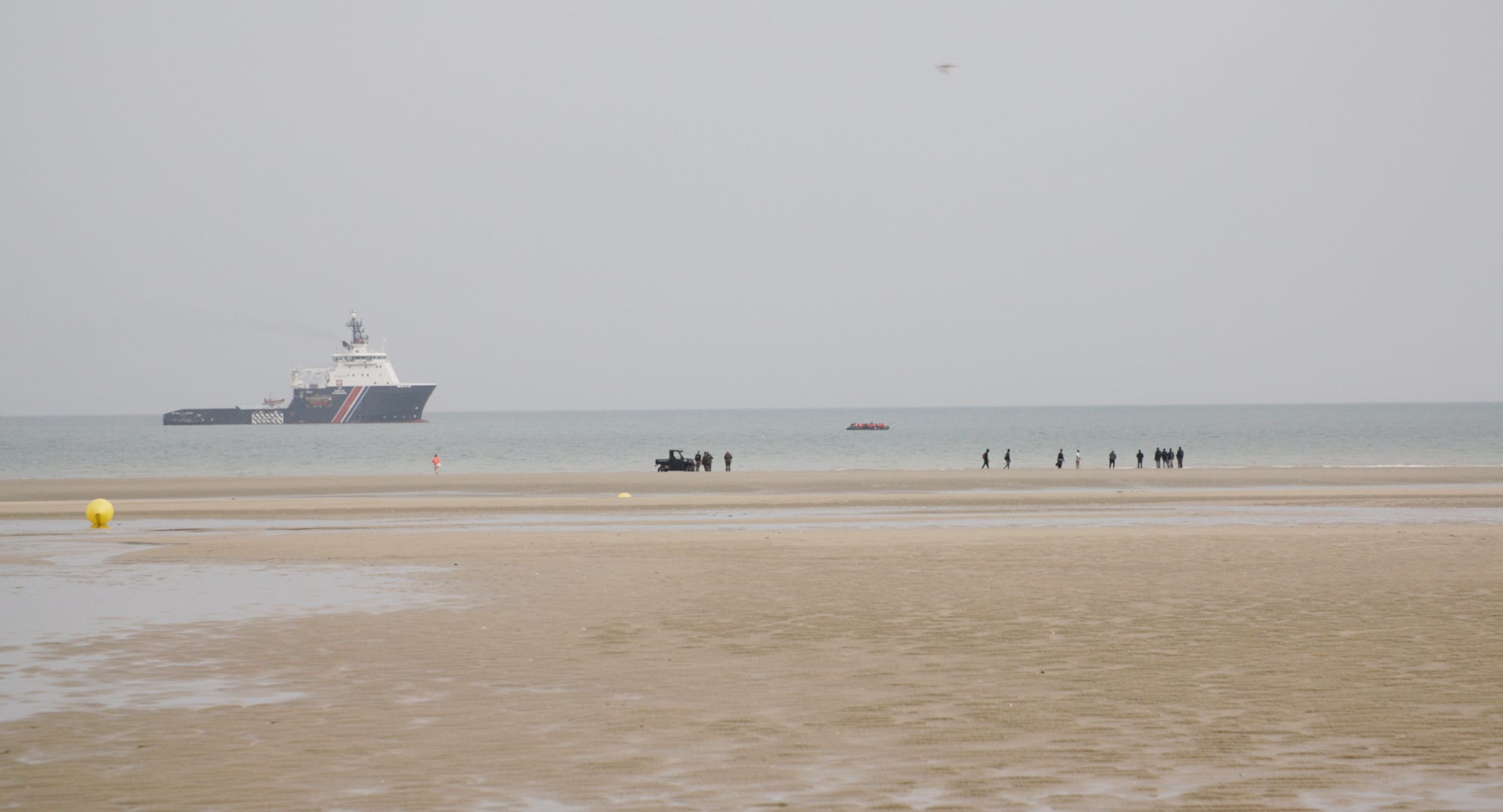
There was a small crowd of displaced people on the shoreline watching on. Given there was already a police presence on beach I was surprised they hadn’t fled. This was before I understood what a taxi-boat really is: it starts further down the coast and, like a taxi, picks people up on the way. It looked pretty full to me already but the people gathered on the shoreline were hoping it would get close enough for them to wade in and jump on. A life boat was alongside the boat as it floated in the wrong direction. Had the engine had failed?
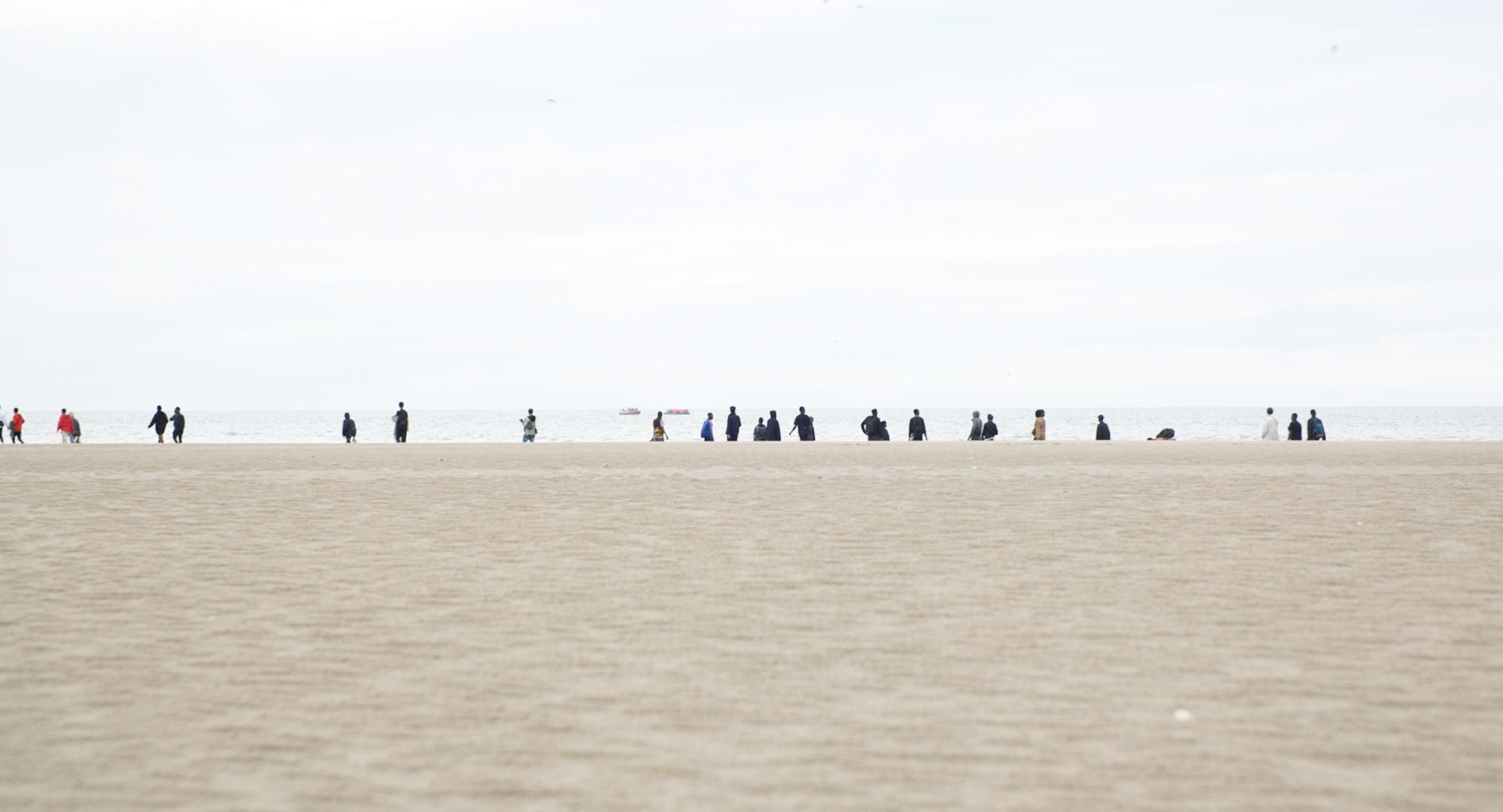
There is a duty in international maritime law to rescue people in distress at sea regardless of who you are. It is legal for the border police to prevent a boat and its people from getting into the sea, provided the force they use is proportionate. Once the boat and its occupants are at sea the legal framework switches to search and rescue and preservation of life. The exact point at which an operation intending to stop a Channel crossing switches to preservation of life is a fine line.
For a person attempting to cross to the UK there are two critical moments. First, getting afloat in the boat so the police can no longer intervene. Secondly, the dingy not sinking before making it into British waters. If you have to be rescued in French waters you are returned to France, and you find yourself back at square one.
A gendarme came over to the Angèle and Roman to ask if they had any information about a Turkish child who had become separated from the parents in the chaos. The policeman seem genuinely concerned. I was informed he was most likely one who had recently been drafted in.
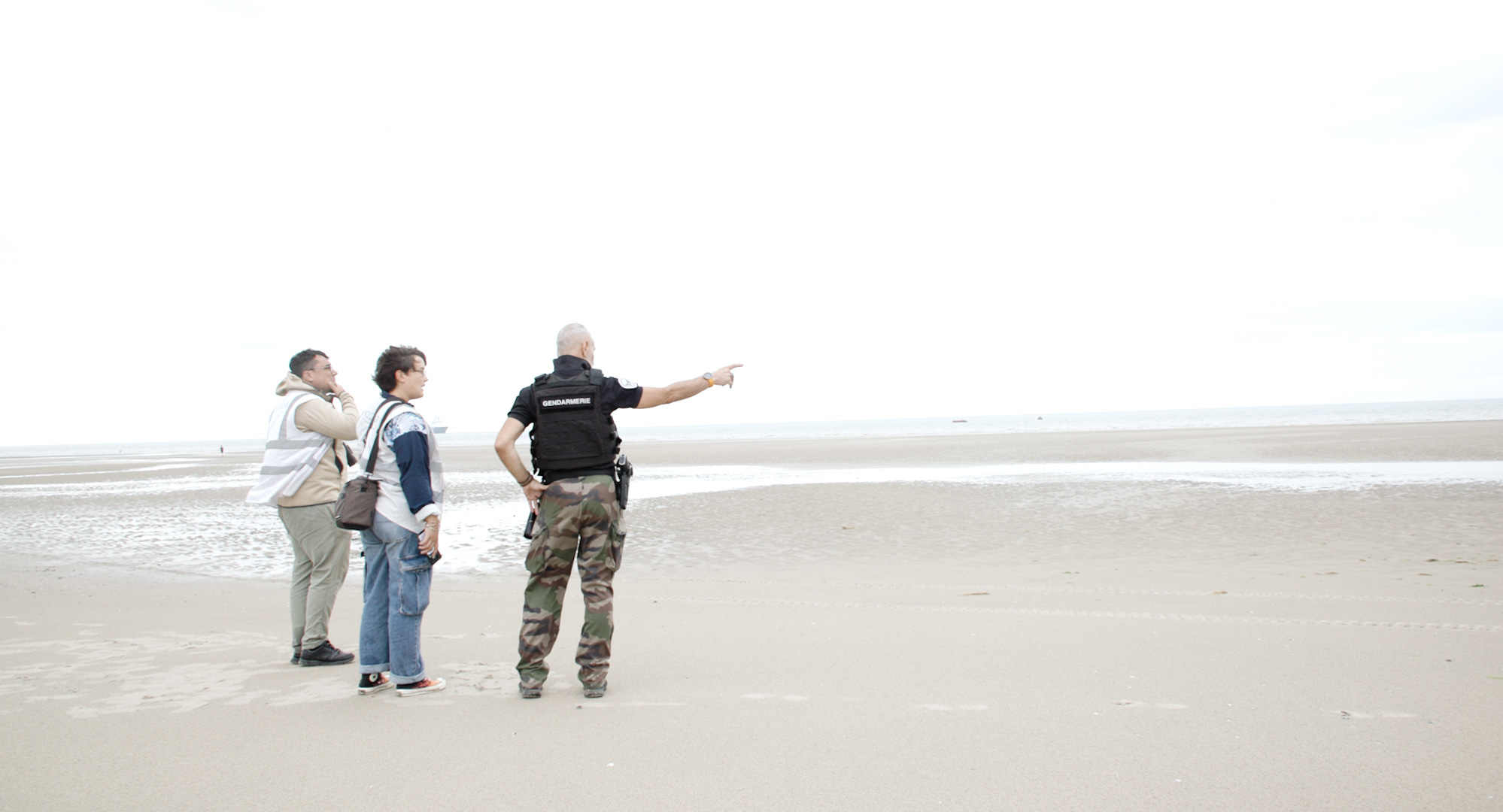
Early morning joggers were out on the beach. It was a strange and awkward juxtaposition of normal life playing out while, on the very same beach, a humanitarian crisis was unfolding in front of my eyes.
A police buggy raced across the sand. Further along the beach, a large group had suddenly appeared from the dunes clad in distinctive orange life jackets. They were carrying a dinghy. Desperate to get away, perhaps they thought they could make it before the police got across to them from their position surveilling the other boat. The group didn’t even make it off the dunes before I heard the ‘pop pop’ of tear gas and watched on as a plume of gas enveloped them. The boat deflated, slashed by the police. The crowd dispersed. We covered our faces as the gas cloud started to blow in our direction, I felt the remnants sting my eyes.
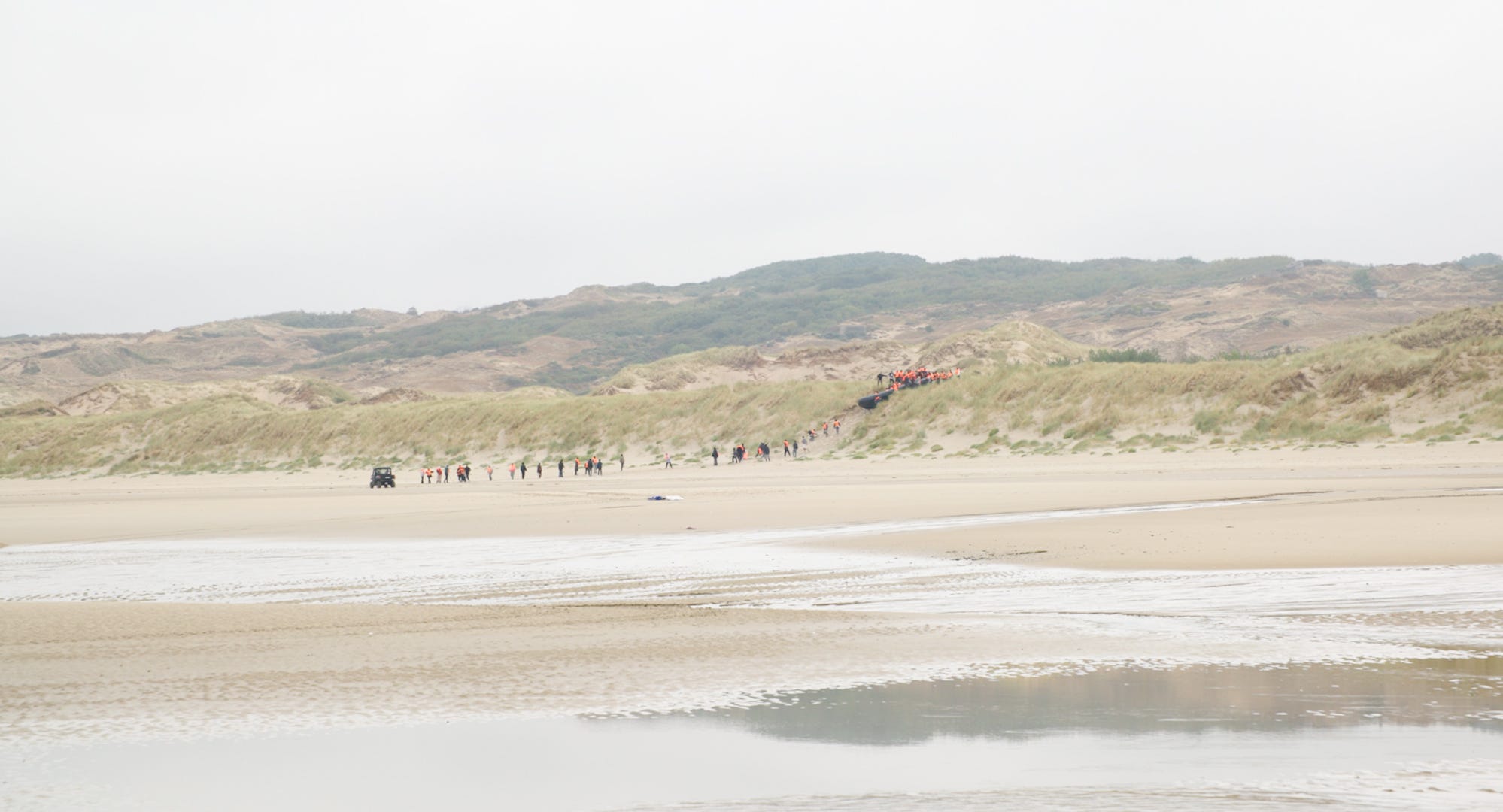
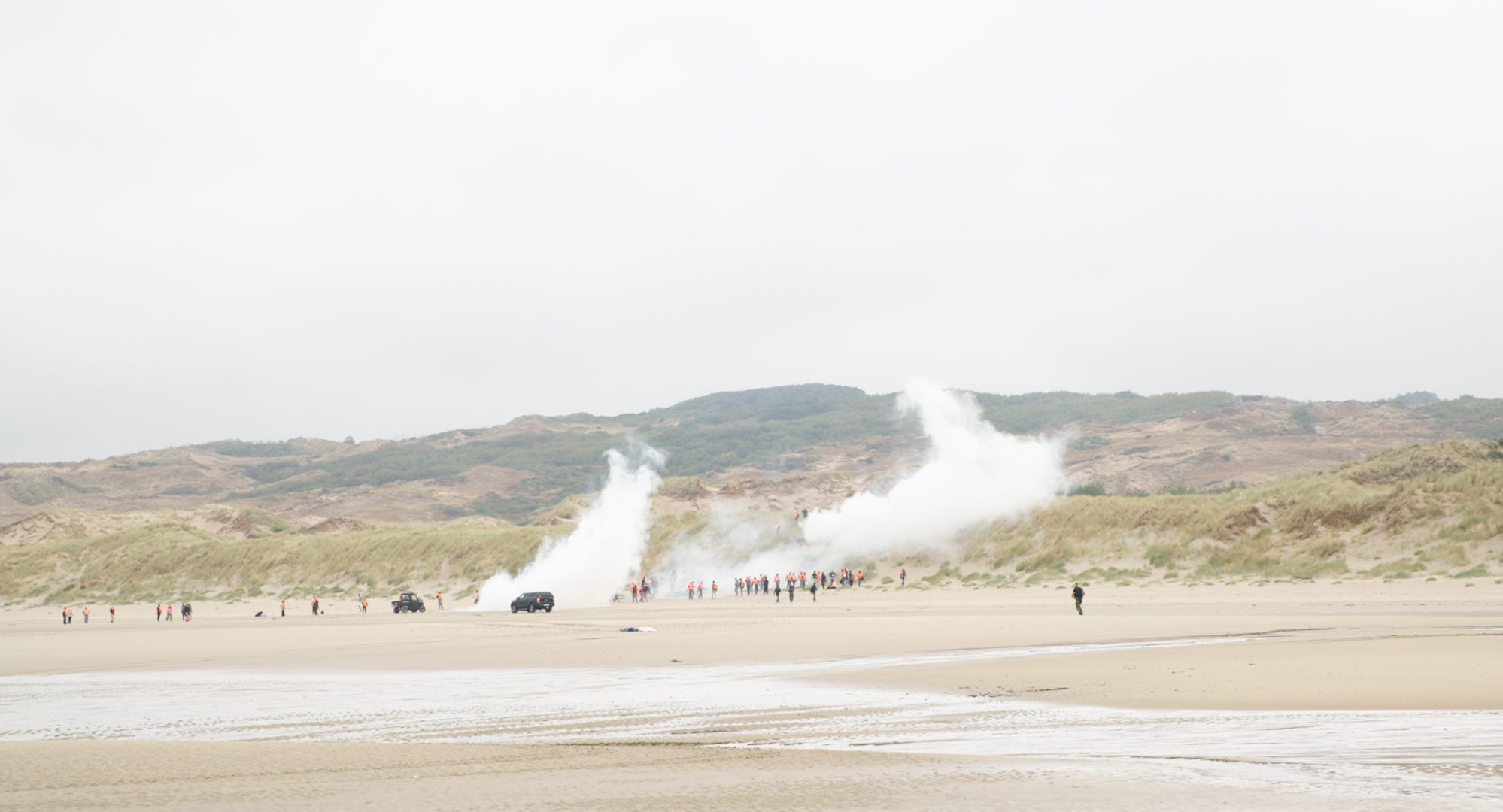
Angèle turned to her colleague and asked, “have we got enough saline solution in the van?” They readied themselves to get to work, there were going to be a lot more people in need of help than they had been expecting.
First I saw a group of young women appear. They were soaked to the skin from being in the water. Still fully clothed, they tried to shower the sand and salt off using the showers usually occupied by beach goers in bikinis and swimming trunks. I was struck by the white handbag one of the girls had with her. Through my lens, it seemed a surprising accessory to be carrying with you on a crossing attempt, but for her it was a practical solution to carry those few essentials she needed. It was also a reminder that refugees are just like you and me, and why wouldn’t she want to have a nice bag too?
Meanwhile the taxi boat appeared to have got its motor working and was disappearing off into the distance, in the direction of England.
Angèle and Roman started unloading boxes of clothes from the van. A group of Boulogne locals were also at the scene with food and drink. The young women started to rifle through the boxes to find dry clothes that would fit. The Utopia van was packed to the gunnels, but there is only so much you can fit in one van. You need clothes that can fit anything from a baby to a tall man as well as shoes for all sizes. Ideally they needed a tardis, not a van. A woman asked for some dry shoes. No, the shoes had to be kept for someone who had none at all.
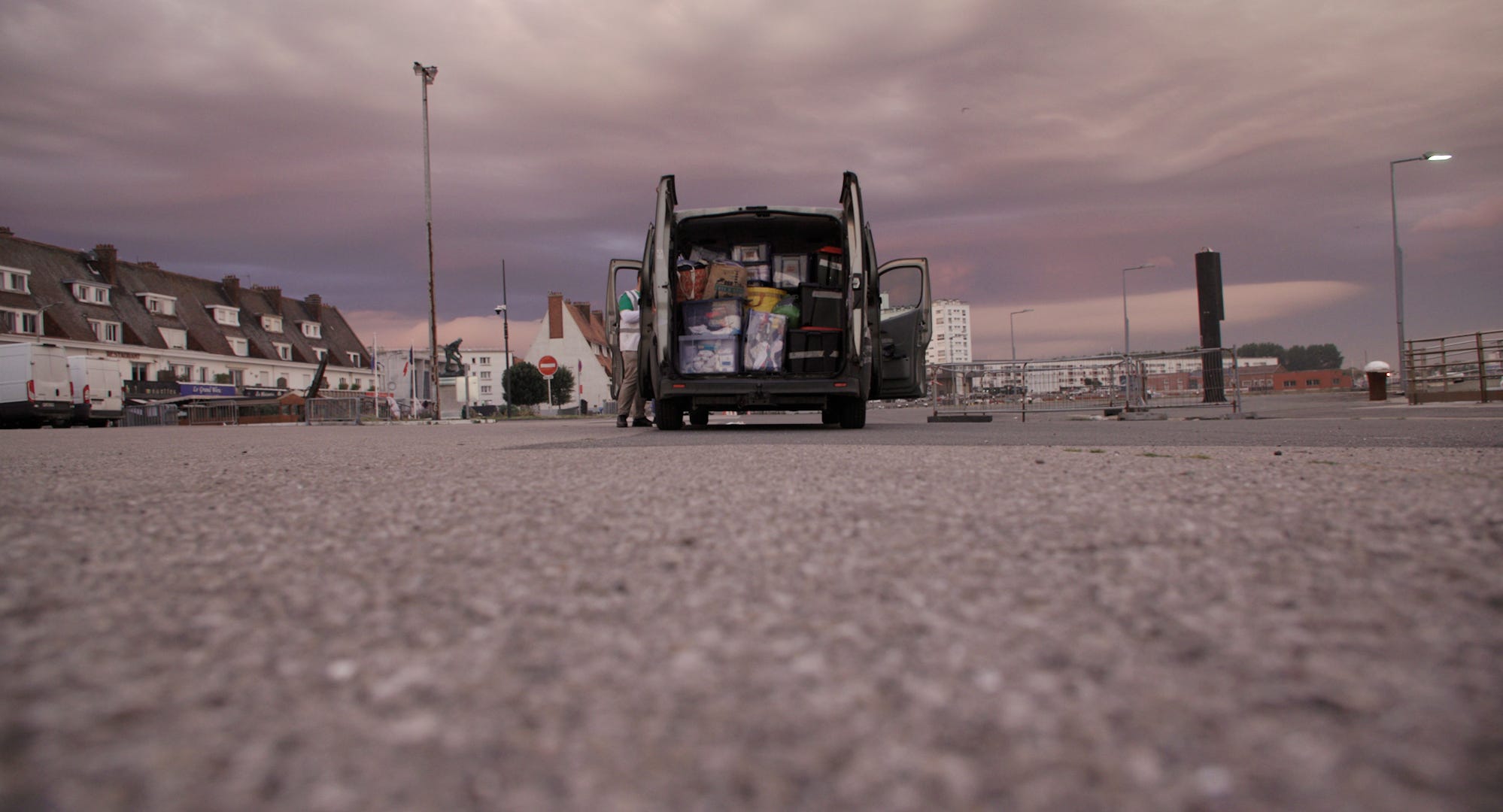
The Utopia van at dawn in Calais, preparing to head further down the coast.
Meanwhile, sailing club was beginning and more holiday makers began to use the beach. Angèle and Roman pointed to a group being rescued further away. The tides in Boulogne can easily catch people out and a group were stranded on a sand bar. Many of the people I have spoken to who have attempted crossings have told me they can’t swim.
Some wore a plastic pouch around their necks to protect their phone and any papers they had, otherwise they just had the clothes they were wearing on their backs. As I look around my home with all its clutter, it is hard to imagine owning absolutely nothing but the clothes on your back. The people I met had also had homes and their own clutter once upon a time.
As I walked up towards the van I spoke to an incredibly polite middle aged man from Iran. His eyes welled up when he discovered I was English. He had been hoping to get on the taxi boat but it had not made it close enough to shore. He recounted his story to me in near-perfect English. It turned out he is an academic with a list of qualifications longer than my arm and an existing support network in England. If he were to get asylum in the UK he would be able to live a normal life, thrive and contribute. He has a UK immigration lawyer but they can only apply for asylum for him if his feet are on the ground in the UK. When he asked his lawyer how he could get to England, they said they could not answer that for him, but that he must find a way. Unlike me, he can’t get on a plane, or a ferry, or take a train through the tunnel. There is no safe and legal route for him to get there. As things stand today, the only option left to him is a small boat or hiding inside a lorry. Doing this clearly made him deeply uncomfortable. He told me he’s not really cut out for this kind of ducking and diving, but what choice did he have? Returning to Iran is not an option. The regime there consider him a dissident. I don’t have to spell out what the Iranian regime would do to you if they thought you a dissident. He could not stay in Europe because his visa in the European country he had legally been working in was expiring and a confluence of reasons meant he could no longer remain there. He had nowhere to go but the UK.
As the day went on and we moved to a different location, more and more people arrived at the van. They told us a group of Somali women were on their way. When the women arrived they quickly gathered around Angèle. A woman’s needs are different to men’s. One woman told me she was pregnant and needed medical attention. She was exhausted. Angèle told me she has noticed an increase in the number of women and children in the camps. There is no official explanation for this yet, but I can’t help but wonder if there is a correlation with Shabana Mahmood’s recent suspension of the family reunion route?
A group of about thirty sat along a brick wall next to the van eating banana cake while they gathered their energy for the long journey back to the camps in Calais and Dunkirk. As they sat there, a group of young riders clopped past on horses, dressed in immaculate jodhpurs and wearing identical shiny new black helmets. It was Summer pony club and another uncomfortable juxtaposition of these parallel lives playing out in the same space. I wonder what those young horse riders thought of what they saw?
The police violence towards these people may not be quite as violent as on the Libyan coast, but it is still police violence against human beings sponsored by the UK tax payer.
I still don’t think many people think of what is happening on the French border as a humanitarian crisis in the way we do when we hear reports of refugees fleeing far flung countries, but this is what it is. I mean, how is what is happening on our doorstep acceptable to us? Perhaps it’s the visual disconnect of where it is playing out, alongside fancy villas, nice cafes and sailing clubs. The police violence towards these people may not be quite as violent as on the Libyan coast, but it is still police violence against human beings sponsored by the UK tax payer. I know this doesn’t sit comfortably with all the Boulogne locals either because I met some who have organised among themselves to come out and help. There was a moment when we were pulled up on the curb so Roman and Angèle could help another family. I was sat in the front of the van when a man popped his head in and handed me a bag. It was a donation of clothes he had gathered from his home.
We moved onto another area where the French medical emergency services were assisting a group who had been in the sea. An Afghan family had been separated. The mother was on the taxi-boat, her children along with their father and aunt were on the shoreline. I pondered why the mother had chosen to stay on the boat. Then it occurred to me, perhaps she didn’t have a choice. Perhaps she literally couldn’t get out. These boats are crammed and if you’re in the middle you would be stuck. Perhaps she couldn’t swim. Or maybe they thought it better for one of them at least to get to the UK. We will never know, but this filming trip was highlighting for me yet another distressing outcome of this chaotic and broken asylum system, that of the heart break of family separation. Her sister was sat by the ambulance, a shiny space blanket wrapped around her. She was hunched over in tears. A young boy was changed into dry clothes and began playing on a nearby statue. A casual onlooker would have thought he was just like any other six-year-old boy on holiday there. And of course, that is exactly what he is: a six-year-old boy whose life we should value as much as that of any child.
The humanitarian work continued into the late afternoon. It’s exhausting work. I asked Roman how he didn’t burn out. His reply was along the lines of, “at least I feel I was able to help some people today.”
The UK government are positioning their new deal with France as a success story, and yes I did indeed witness the French authorities stopping a boat from taking to the water. But what has this policy really achieved?
For starters, it has made it more dangerous for the people attempting the crossings. The boats are leaving from departure points further down the coast to evade the increased surveillance. This makes the journey longer and, in turn, more perilous.
The departures are becoming more and more chaotic which means families are getting separated on the beaches.
Greater numbers are attempting to get on the boats. Last year it used to be somewhere between 30 or 40 per boat, now it is more often 60+. And even more recently the smugglers have responded to the crackdown by running even more dangerous mega-dingies. More people means overcrowding which means more danger. Two young Sudanese woman suffocated on a boat recently. Utopia report that at least 10 people have died during the first 3 months of the new agreement. HRO and Utopia are reporting an up tick in the number of people getting injured by the French police. This sits counter to the narrative that the French and British authorities are using to defend the police action: they say they are saving lives by stopping the boats, when in truth, it is having the opposite effect.
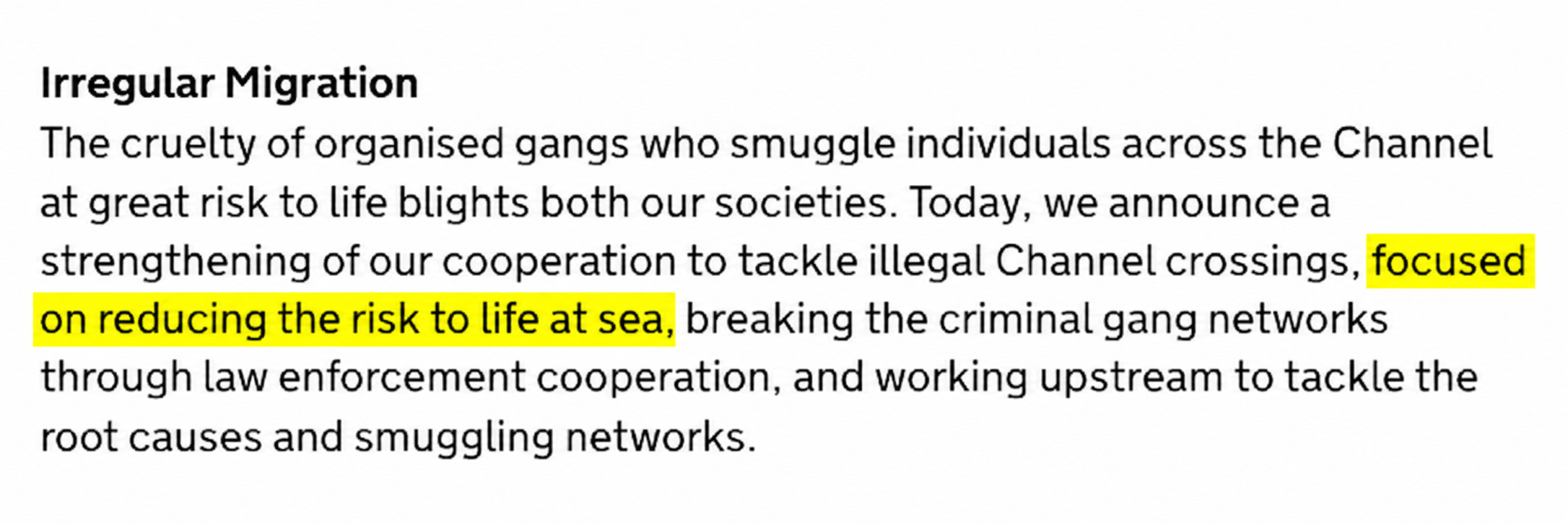
Excerpt from the UK-France Leaders Declaration press release published 10 July 2025
This new deal also means we are burning a £662 million pound hole in the UK tax payer’s pocket to fund this circus. Ironically, that money doesn’t even appear to be appeasing the anti-migrant protest groups.
There is no perfect solution to this humanitarian crisis and our broken asylum system, but what if the Iranian professor had a legal way to apply for asylum in the UK from where he is in France? He wouldn’t need to take a boat and the smugglers wouldn’t have a business.
No thought appears to have been given to what happens to those who have been prevented from crossing. They don’t just disappear. Most re-set and wait for the next good weather window to try again. Most will continue to try again and again, because getting to the UK is their only hope. There is no perfect solution to this humanitarian crisis and our broken asylum system, but what if the Iranian professor had a legal way to apply for asylum in the UK from where he is in France? He wouldn’t need to take a boat and the smugglers wouldn’t have his business.
The UK government said of the new agreement, “This partnership complements the important reforms undertaken by the UK government to reduce the pull factors that push irregular migrants across the Channel”. They obsessively talk about the pull factors. I asked a dear and kind friend why he thought people cross the channel on small boats and he thought it was so they could come and claim benefits in the UK. That couldn’t be further from the truth, but it is a narrative that has been spun so widely that this is what he believed. Perhaps the first step to solving this is not to focus on the pull factors but to concentrate on the push factors instead?
The Refugee Convention came into being because of the atrocities of the Second World War, and woe betide us if we ever forget why. Among its guiding principles are that of non-refoulement - you cannot return a refugee to a country where their life or freedom is threatened. You cannot punish someone for entering illegally if their life or freedom is threatened. And, it should be applied without discrimination, no matter where you are from or who you are.
While I have been making this film I have had the opportunity to meet many displaced people who are trying to find safety and start a new life in Europe. I have been able to speak in depth to some who I share a language with. Not a single one of them has ever made me feel scared. I have never tried to engage with the people smugglers who are exploiting the situation - that’s a different bag altogether. My overwhelming take away has been that they are just human beings like you and me. The black clad balaclava men who blockaded the roads in Dover last week are far more scary than the people I have met attempting to cross The Channel or the Polish/Belarus border. The British anti-immigration protesters see the people on these boats through a very different lens to the one that, through my work, I have had the privilege of looking through. For them, they are a dangerous strangers invading their shores. This is because they have been completely and utterly dehumanised.
My task now is to complete the edit of Nowhere To Go so it can go into online post production in January and be ready for its cinema release in the spring. Over these last four years I have simply documented what I have witnessed directly with my own eyes. It is the story of our broken asylum system and the extraordinary spirit and journeys of humans who are caught up in it. If you would like to be among the first to see footage from Nowhere To Go please join me, and a panel of special guests, in Manchester on 1 November. That event is also serving as a fundraiser for the film’s finishing funds.
Coming up
I am looking forward to a couple of months of thought-provoking events relating to my films. I hope you can join me for some of them.
On Friday 18th September, Sustainable Hackney are screening The Conspiracists. I will be there for a Q&A hosted by Media Revolution’s co-founder Liz Pendleton.
On Wednesday 21st October I have been invited to give an artists talk at Derby Museums: The Omnicrisis: Power, Truth and Division. Tickets now available.
On Monday 26th October we are running an event in parliament, sponsored by Clive Lewis MP, relating to the issues raised in our film The Line We Crossed. You can get involved from your armchair by petitioning your MP to attend!
On Sunday 1 November, the Quakers in Manchester and I are hosting a very special event where attendees will be among the first to see preview clips from Nowhere To Go and hear directly from one of the people in the film who crossed The Channel in a small boat. Every ticket and donation from this event goes directly towards the finishing funds for the film. Tickets are now on sale.
It would be a great help if you could help spread the word by sharing information of these events around your networks.
This is an absolutely fantastic piece of writing. Thank you Liz for your contribution and your moral courage. You have fully shed the light on a humanitarian crisis that many think will simply disappear if we simply looked away; The same attitude is given to Gaza, not surprisingly. It is sad seeing the misinformation wars calling this by one word: crisis, without the much needed other word, humanitarian.
Looking forward to seeing your movie, Nowhere To Go, it is looking to be enlightening indeed.
Thank you, Liz, for another thorough, informative, heart-breaking documentary that shines light on people and issues that most of us know only in the abstract. Your first-hand witness and engagement forces us to drop our indifference and demands that we wake up and realize what is happening daily to our fellow human beings. The fact that our wildly privileged nations can characterize people fleeing violence and poverty as “criminal” and less than human speaks volumes about what arrogance, fear and ignorance does to perpetuate suffering in the world.
Thank you for continuing to hold up a camera and also a mirror for all of us.
- Deanne Larsen